

The Infrastructure Behind the Reference
A conversation with Andy McCune, founder of Cosmos, on building a platform that serves creative thinking instead of replacing it
Hi everyone,
A few weeks ago I wrote about research practice as a form of creative identity, and the gap between collecting images and actually thinking through them. The response told me something I already suspected: a lot of us are navigating this quietly, building workarounds, going offline, scanning things that have never been digitised, because the platforms that are supposed to support creative research have slowly become part of the problem they were meant to solve.
The issue is structural. When a platform is optimised for engagement, it surfaces what people already respond to. When it surfaces what people already respond to, everyone’s references begin to converge. That convergence is not a failure of individual taste so much as a predictable outcome of a particular kind of infrastructure. Researcher Kate Crawford has described this as aesthetic flattening, and it is one of the defining conditions of image culture right now: everyone drawing from the same water, producing work that is technically strong and intellectually indistinguishable. The tools we use are not neutral. They shape how we see, what we reach for, and eventually what we make.
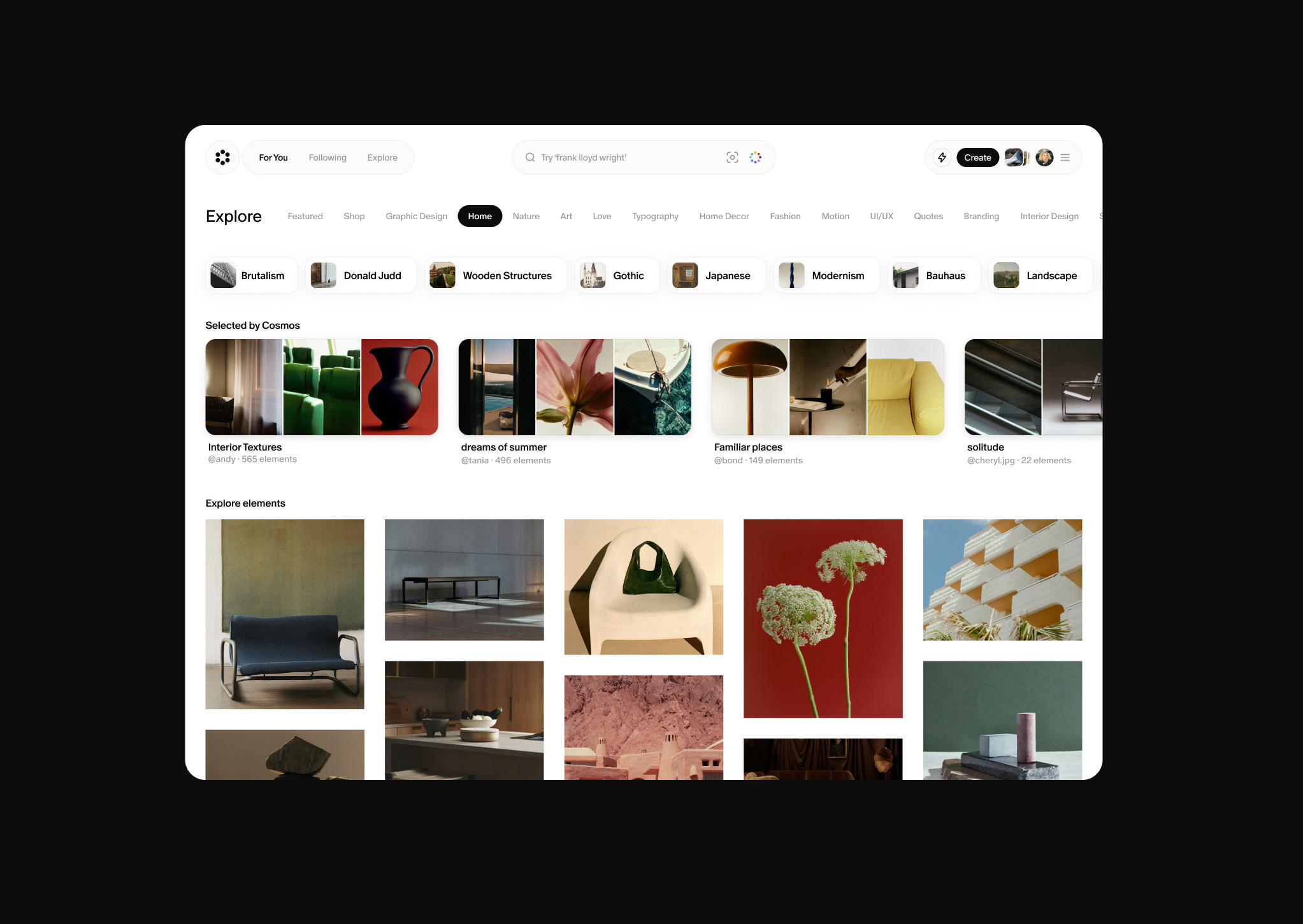
Cosmos was built from a specific position on this problem. As someone who, besides scanning vintage magazines and looking outside the internet for inspiration, I’m also a big fan of Pinterest and Instagram alternatives that drew me to new types of inspiration. Andy McCune, the founder of Cosmos for example, has spoken about believing that creatives are only as good as their source material, and that the current image ecosystem has been working quietly against the quality of that material for years.
The platform has grown to millions of users, is used by creative teams at Nike, Apple and others, and recently raised a $15 million Series A. But what interests me most is not the scale. It is the set of decisions behind it: the choice to restore provenance to images so that context travels with them, the choice not to serve ads, the use of AI for attribution rather than generation, the deliberate seeding of the algorithm with a curated community instead of letting engagement data alone determine what surfaces. These are infrastructure decisions, and infrastructure decisions are always also philosophical ones.
For today’s newsletter I am super excited to have my very first interview on ART DIRECTION with Andy.
Zoe: You have described building Cosmos from a belief that the internet lost something specific in the last decade, when images became content and inspiration became noise. What was the moment that made that feel like a problem worth building a company around, rather than just a cultural frustration to live with?
Andy: It was more of a recurring feeling than a specific moment. I’d save an image because something about it hit me, and then I’d lose it. Sometimes literally — buried in Instagram saves or a pile of screenshots — but I’d also lose the thread of why it mattered. If I found it again, the context that made it click was gone.
It wasn’t that good inspiration vanished. What disappeared were the conditions that let images mean something. The feed replaced images and inspiration with Reels and short-form video. It became a minefield of hyper-optimized 2 second hooks grabbing for your attention. You adjusted, started scrolling faster. And eventually you stopped really seeing anything.
The shift from frustration to building a company came from realizing that wasn’t inevitable. It was a product decision. Someone decided the feed should work that way, which meant someone could decide differently.
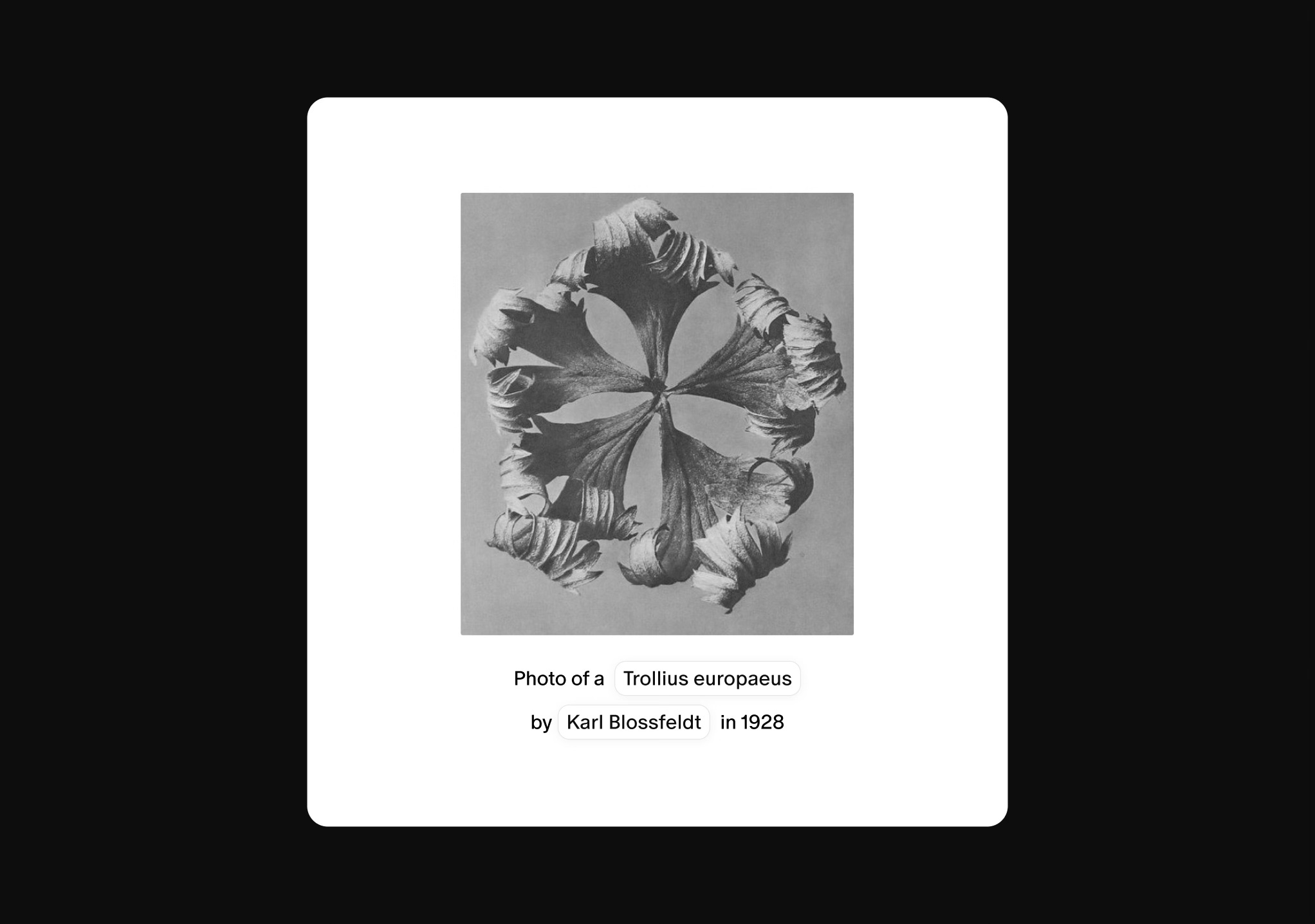
Zoe: One of the things Cosmos has done that I find genuinely radical is build a system that restores the source to images: who made something, when, in what context, and what its cultural lineage is. Before a reference gets reposted, the credit disappears, the original meaning dissolves into the new one. What does that loss of context actually cost us, not just ethically but creatively, in terms of how we think and what we make?
Andy: The moment an image gets reposted, credit disappears. The poster, not the artist, is foregrounded. Everything is seen, but little is understood. No one knows who made it, when, or why. That’s a fundamental break in how creative work should be understood and built upon.
When we research an image on Cosmos, we’re asking basic questions that should never have been lost: Who made this? When? Where was it published? What’s its cultural lineage? Imagine walking through a museum and not being able to read the plaques on the wall. Knowing a photograph is from 1973 Tokyo versus 2019 Brooklyn is meaningful.
Creators deserve attribution. People deserve context. And inspiration needs roots. Beautiful images become more beautiful when you understand the story behind them.
Zoe: The decision to seed Cosmos’s algorithm with a curated community over letting pure engagement data determine what surfaces is an unusual one. What did you learn from making that choice, and what would the platform look like today if you had not made it?
Andy: If we’d let pure engagement data lead from the start, Cosmos would look like everything else. The most-saved images would surface most, which sounds logical until you realize that optimizing for saves is just optimizing for familiarity. You end up in a loop — popular taste confirming itself, and anything unexpected or tailored to you gets buried before it finds its audience.
Seeding with a hand-selected, curated community meant the algorithm learned from people who had points of view. These are not only prolific curators, but also discerning ones. That’s a different signal. It meant the platform developed a sensibility before it had scale, which is much harder to retrofit than to build in from the beginning. Quality of input determines quality of output in ways that compound over time.
Zoe: The platform’s value depends partly on the quality of what the community brings to it. How do you protect that as you grow, particularly as the audience expands beyond people who came to Cosmos already knowing what they were looking for?
Andy: The question isn’t really about scale, it’s about what flavor of taste the platform is organized around. Plenty of large platforms have strong aesthetic cultures — places like Tumblr, or more fringe like 4chan. The issue is whether that culture is driven by quality or by consensus, and those aren’t the same thing.
What distinguishes Cosmos is the quality of the imagery. When the inputs are high enough, the platform develops a gravitational pull. New users orient toward it. The standard becomes self-reinforcing.
That doesn’t happen by accident. We’re onboarding a curated set of artists, designers, and archives through verified profiles — people whose body of work and taste set the tone for everyone who follows. That’s what determines whether a culture compounds or collapses as it grows.
Zoe: AI can now generate a technically competent image in seconds, which raises a question the creative industry has not fully answered yet: what is the irreplaceable thing that human visual intelligence actually offers? Where do you think the line sits between what AI can do in the image space and what it fundamentally cannot?
Andy: AI can generate an image, but it can’t have a motivation for making it.
Human visual intelligence is relational. A photographer deciding what angle to shoot, a designer choosing a reference — those are acts of judgment that come from a specific life, a specific set of obsessions, a specific emotion. The image is the output. The point of view, the backstory, the desire is what feeds that.
AI can synthesize everything that’s come before with good-enough fidelity. But it has no stake in the result, no experience that preceded it. People feel that difference even when they can’t articulate it. The line sits at intention, desire, and passion.
Zoe: There is a real tension in building a platform for creative research: the moment something surfaces widely enough to be useful, it begins to enter the shared visual language and loses some of what made it interesting. We have watched this happen to entire visual languages in real time. Do you think genuine creative originality is still possible in a culture this saturated, and what does it actually require from someone who wants to protect it?
Andy: I’d make the case that genuine originality has never existed, and that letting go of that idea is freeing.
Your work is a reflection of your inputs. References, context, emotional state, the specific problem you’re trying to solve — these converge with something harder to name, a creative force that’s yours alone, and produce an outcome. But that outcome was always coming from somewhere.
What actually differentiates creative work isn’t the absence of influence, it’s the singularity of the vision. The particular combination of references, the mindset you brought, the moment you were in. Two people with identical influences will make completely different things because the human variables are irreducible.
So the question of protecting originality is the wrong question. The real question is how intentional you are about what you’re absorbing and why. That’s what Cosmos is built for. Not to help people avoid influence, but to help them have a deeper relationship with it.
Zoe: The creatives who use Cosmos most seriously, as a genuine research tool and more than just a collection habit, what do they do differently? What separates someone building a real visual practice through it from someone who is essentially curating beautifully?
Andy: In the early days, Cosmos was mostly creative professionals — designers, art directors, photographers — people pulling references for specific projects.
But what we’ve found is that the gap between those two uses is smaller than it looks. What closes it is giving people the tools to go deeper, with multiple ways to search and filter, by color, by image, by filtering out AI-generated content. It’s about the ability to follow a thread, and fall down rabbit holes they didn’t know existed. Whether you’re a creative director building a reference deck or someone who’s obsessively into clock-face design (a real person on Cosmos), the experience of discovery should feel the same, like you’re opening a door into a whole new visual world.
Zoe: There is a lot of creative advice that tells people to be more intentional about their research, to slow down, to ask questions of every image before they save it. But instinct also matters. Something can hold your attention before you know why, and the why only surfaces later. How do you think about the relationship between instinct and intention in the way creatives actually build a visual practice?
Andy: Instinct and intention aren’t a sequence, they’re in dialogue. Something stops you before you know why. You save it. Later, looking back at what you’ve collected, the why surfaces. But then that understanding sharpens your instinct the next time. They feed each other. But, you also don’t need to look back. The process of choosing inspiration trains your intuition, your taste. This is a muscle, even if you don’t dive back into what you saved.
Interrupting instinct with interrogation kills the flow. We want the experience of using Cosmos to feel like flying — moving fast, following the pull, falling into visual worlds. The user experience keeps you in that flow, so when you’re ready to step back and ask what your collection is telling you, everything you need is already there.
Zoe: What do you think the next decade looks like for image culture, specifically for how working creatives build archives, protect the integrity of their source material, and maintain a point of view that is genuinely theirs rather than a product of what the algorithm has shown them?
Andy: The feed was designed to move you along, and in moving, it flattens. Everything gets the same real estate, the same lifespan, the same context-free scroll.
What’s missing is an environment where visual work can actually live and breathe — where a creative’s archive is permanent, discoverable, and treated with the same care as the work itself. Museums and institutions have figured out versions of this. Creatives haven’t had anything that comes close.
That’s what the next decade looks like to me, and what Cosmos is built for. A design environment where inspiration has a home — where your archive grows with you, stays discoverable, and reflects a point of view that’s genuinely yours rather than a product of what an algorithm decided to show you.
What stayed with me most after this conversation was Andy’s answer on originality, specifically the idea that the question of protecting it is the wrong question entirely, and that the real work is in how intentional you are about what you absorb and why.
That reframe feels important. A lot of anxiety in creative circles right now is pointed in the wrong direction, toward avoiding influence, toward finding something no one has referenced yet, toward originality as a kind of purity. But the images that carry genuine authority have never come from nowhere. They have come from a particular combination of sources, a specific moment, a point of view that was built slowly and deliberately over time.
What Cosmos is trying to offer, at its best, is the infrastructure for that kind of intentionality. Not a shortcut to originality, but a better environment for the real work that produces it. That feels worth paying attention to.
Would love to hear your thoughts on this topic.
Love,
Zoë
This post is NOT sponsored by Cosmos.

Fantastic read. As a creative dodging burnout who recently started using Cosmos, my intentionality behind research has begun to sharpen again and I actually look forward to mood boarding now.
Thank you for this, Zoë!